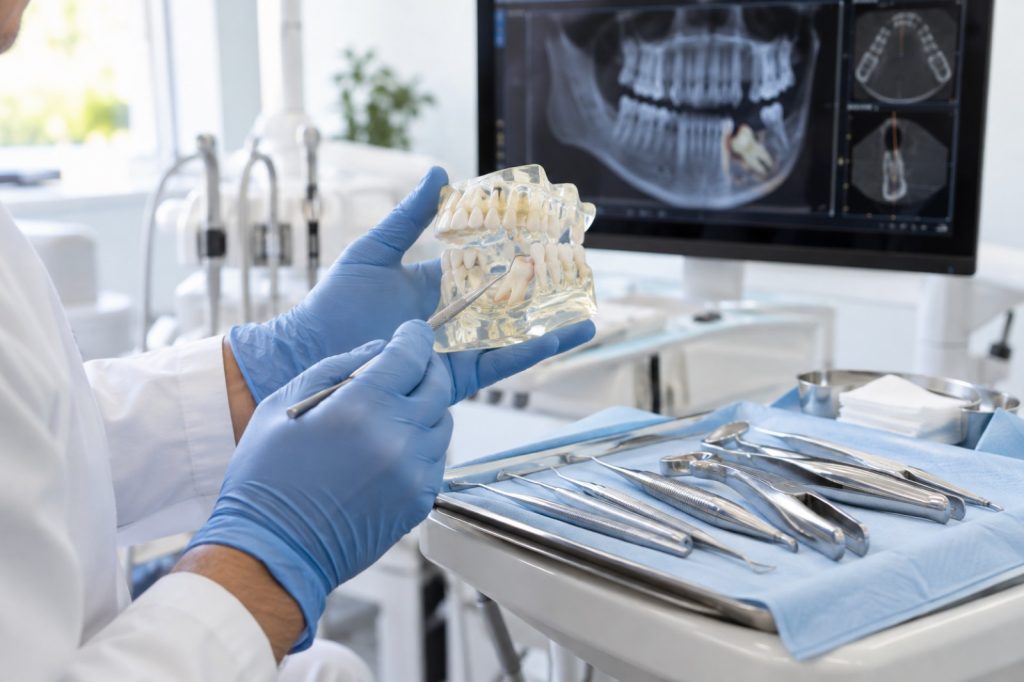
Surgical extractions are necessary when a tooth cannot be removed using standard forceps techniques because it is trapped beneath the gumline, fractured at the root, or firmly anchored in bone. We utilize advanced 3D imaging to plan every step safely. We help you address:
Removing teeth that are partially or fully impacted beneath the gum tissue.
Extracting teeth that have broken off near the gumline or jawbone.
Clearing teeth with curved roots or bone fusion that prevents simple removal.
Minimizing trauma to surrounding tissue during complex surgical procedures.
Approaches
Comparing Extraction Approaches
Feature
Surgical Extraction
Simple Extraction
Tooth Position
Impacted, broken below the gumline, or trapped in bone
Fully erupted and visible above the gumline
Surgical Technique
Requires a small gum incision and potential sectioning of the tooth
Uses forceps and elevators to lift the tooth directly from its socket
Imaging Required
Advanced 3D CBCT imaging to map roots and nerve pathways
Standard digital X-rays to assess visible crown and root structure
Process
The Surgical Extraction Process
1. 3D CBCT Imaging
We use advanced 3D scans to map your exact root anatomy, bone density, and nerve pathways before your procedure.
2. Comfortable Anesthesia
We thoroughly numb the area with local anesthesia. You will feel pressure, but you should not feel sharp pain.
3. Careful Surgical Access
We make a small tissue incision to access the tooth, gently sectioning it if needed for safe and efficient removal.
4. Suturing and Recovery
We clean the extraction socket, place protective sutures, and provide detailed aftercare instructions for optimal healing.
Precision
Surgical Precision in Dearborn
When Dr. Mohammad Hammoud performs a surgical extraction, he relies on detailed 3D CBCT diagnostics rather than guesswork. Impacted and broken teeth require meticulous handling to protect neighboring roots and jaw structures. We plan every step around protecting the structures around the tooth, and if a case requires advanced specialist intervention, we coordinate seamless referrals to trusted local partners.
FAQ
Surgical Extractions FAQs
Why is a surgical extraction required instead of a simple one?
If a tooth is trapped under the gums, broken at the root, or fused to the bone, it cannot be pulled with forceps and requires careful surgical access.
Does a surgical extraction hurt?
No. We use local anesthesia to completely numb the surgical site, ensuring you remain comfortable while feeling only mild pressure.
How long does recovery take after a surgical extraction?
While initial soft tissue healing takes about a week, following our post-operative instructions ensures your bone and gum tissues recover smoothly.
Will I need stitches?
Yes. We typically place dissolvable sutures over the extraction site to protect the socket and promote clean, rapid healing.