Home > Services > Patient Services > Emergency Same-Day Dentistry
A sudden toothache or dental injury requires prompt attention to relieve pain and prevent further damage. We hold emergency slots every day we are open, including Saturdays, to evaluate dental emergencies, stabilize the affected tooth, and get you comfortable again.

Dental emergencies rarely happen at a convenient time. When a tooth is infected or structurally compromised, waiting often allows the bacteria to spread or the fracture to worsen. Our goal is to quickly identify the source of the problem and numb the area so you can relax. You should contact us for an emergency visit if you experience:
Situation | Clinical Issue | Our Approach |
|---|---|---|
Severe Swelling or Abscess | An active bacterial infection has reached the root or surrounding bone | Requires immediate evaluation to prescribe antibiotics or drain the infection |
Knocked-Out Tooth | The periodontal ligaments holding the tooth have been severed | The tooth must be stabilized within 30 to 60 minutes for the highest chance of reattachment |
Lost Crown with No Pain | The underlying tooth structure is exposed but the nerve is quiet | Urgent but not an emergency. We can schedule you within a few days to recement it |

Call our office directly. We will ask specific questions about your symptoms to determine how quickly we need to see you.

Once you arrive, we take a targeted digital X-ray of the affected area to see exactly what is happening beneath the gumline.

We administer local anesthesia to numb the nerve and surrounding tissue, so you should feel pressure, not sharp pain, during treatment.

We address the immediate problem to get you out of pain. If the tooth requires complex restorative work, we stabilize it and schedule a follow-up visit. When the tooth and bone allow it, a broken tooth can go straight to an implant with a temporary tooth in a single visit.
When Dr. Mohammad Hammoud evaluates a toothache, he frequently finds that patients tried to ignore the pain for weeks. Dental infections do not resolve on their own. Even if the pain temporarily stops, it often means the nerve inside the tooth has died, while the infection continues to spread into the jawbone. Seeking care at the first sign of severe pain helps preserve more of your natural tooth structure and limits the scope of treatment needed.
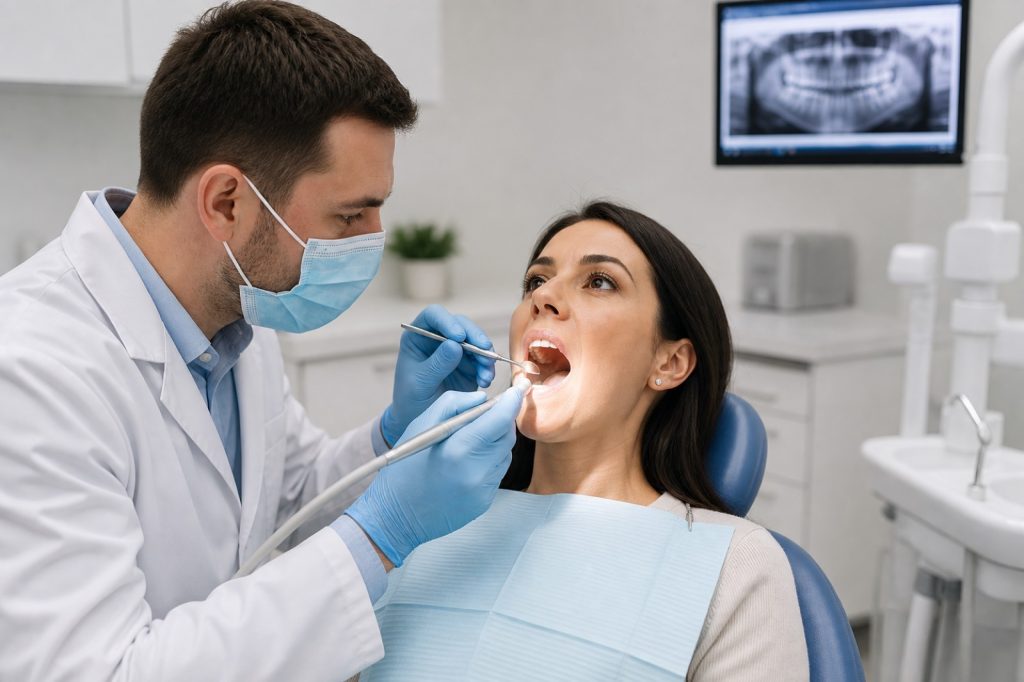
Emergency rooms are generally not equipped to pull teeth or perform root canals. They can prescribe antibiotics or pain management, but you will still need a dentist to fix the tooth. However, if your swelling makes it difficult to swallow or breathe, go to the ER immediately.
You will feel pressure during the procedure, but we use strong local anesthetics to prevent sharp pain. Our priority is getting you numb and comfortable before we attempt any treatment.
Pick the tooth up by the crown (the chewing surface) and avoid touching the root. Gently rinse it with water if it is dirty. Try to place it back in the socket, or keep it moist in a glass of milk until you reach our office.
We highly recommend calling us before you arrive. Calling ahead allows us to prepare a room for you and reduces your wait time, though we will always do our best to accommodate unexpected arrivals in pain.
If you have a broken tooth, severe swelling, or a throbbing toothache, contact our Dearborn office immediately so we can help stabilize your smile.
Reviewed by Dr. Mohammad Hammoud, DMD – 313 Dental, Dearborn, MI